


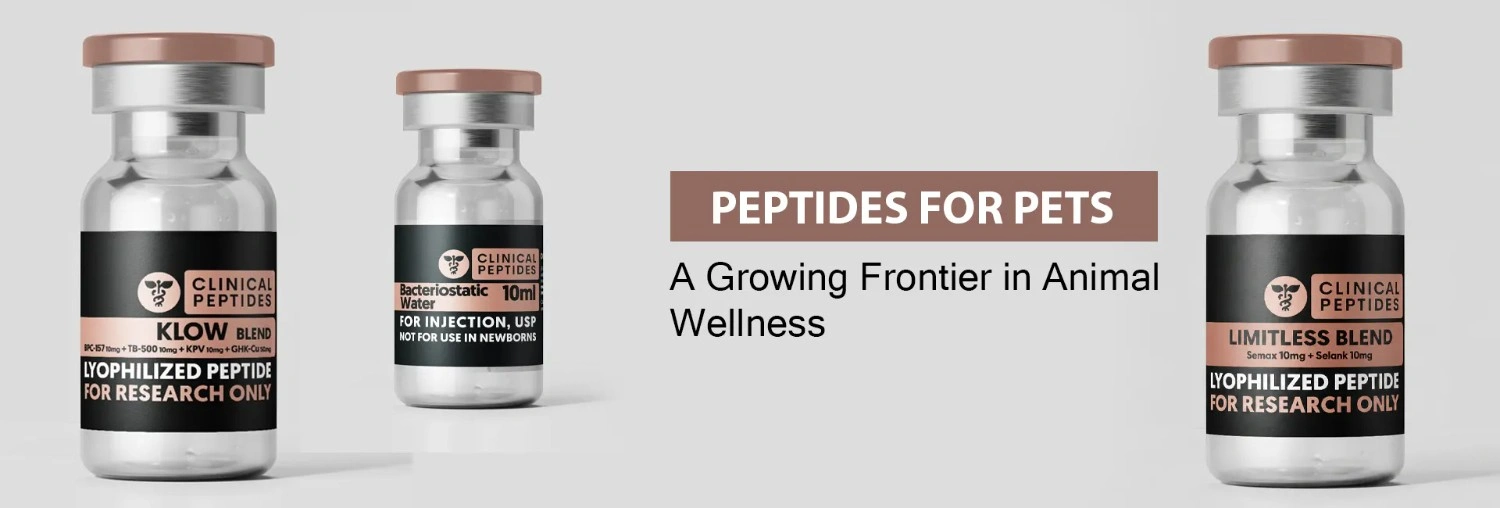
Introduction: What Are Peptides and Why Are They Important for Pets?
In recent years, peptides for pets have gained attention in the fields of veterinary science and animal wellness. Peptides are short chains of amino acids that occur naturally in the body and help in regulating biological functions such as tissue repair, immune signalling, and cellular communication.
As research evolves, peptides are being explored for their potential role in supporting pet health, recovery, mobility, and overall well-being, particularly in aging animals and active breeds.
At Clinical Peptides, we are committed to advancing education and awareness around peptide science and its potential applications in both human and veterinary contexts.
How Peptides Work in Animals
Peptides act as biological messengers. They give a signal to cells to perform specific functions, such as:
- Supporting natural recovery processes
- Assisting with cellular repair and regeneration
- Helping regulate inflammation responses
- Supporting normal metabolic and immune system activity
Because pets, especially dogs and cats, share many biological similarities with humans, peptide research in veterinary contexts is an emerging area of interest.
Potential Areas of Interest for Peptides in Pets
While research is still ongoing, peptides are being studied for various areas related to animal wellness:
1. Mobility and Joint Support
Older pets may become less mobile and develop stiff joints as they age. Researchers are exploring new peptide pathways and their relationships to tissue health and healing.
2. Recovery and Healing Support
Peptides help with tissue signalling and are being explored for their potential to support the body’s natural healing processes after physical activity or injury.
3. Skin and Coat Health
Some peptide-related compounds are known for their role in skin barrier function and tissue maintenance, which help improve coat quality and skin comfort.
4. Immune System Function
Peptides naturally play a role in immune signalling, making them an area of interest for maintaining overall immune balance in animals.
Are Peptides Safe for Pets?
Yes, peptides are safe for pets. But the safety and effectiveness of peptides in veterinary applications depend on:
- The specific peptide compound
- Dosage and formulation
- Species and individual health condition
- Veterinary oversight and guidance
It is important to know that many peptides in pets are still under research. You should always take guidance from a licensed veterinarian before considering any peptide-related therapies or supplements.
Peptides vs. Traditional Pet Supplements
Traditional pet supplements focus only on nutrients such as glucosamine, omega-3 fatty acids, or vitamins. Peptides use a different approach, working at a cellular signalling level rather than simply providing nutritional support.
This emerging distinction is one reason peptides are gaining interest in the veterinary and longevity science communities.
The Future of Peptide Research in Veterinary Medicine
As biotechnology advances, peptide science is expected to play a larger role in both human and animal health research. Areas of ongoing interest include:
- Regenerative Therapies
- Support for Aging Joints and Mobility
- Immune System Regulation
- Natural Tissue Repair Processes
While they are still in research, the future of peptides for pets looks promising as research expands and understanding deepens.
Peptides Studied in Animals: What Research Shows So Far
While peptide therapies in pets are still considered an emerging area of veterinary research, several compounds have been repeatedly studied in preclinical models (including rodents, dogs, and horses) and are frequently discussed in veterinary literature. It is important to note that most of these findings come from animal studies or early-stage research, not large-scale clinical trials in companion animals.
Below are some of the most commonly researched peptides in veterinary and preclinical settings.
BPC-157 (Body Protection Compound-157)
BPC-157 is one of the most widely researched peptides in animal models, particularly for tissue and gastrointestinal research.
Preclinical studies in rats and limited veterinary pharmacology work suggest it also helps to:
- Heal tendon and ligament pathways
- Protect and repair gastrointestinal tissue
- Angiogenesis (formation of new blood vessels)
- Modulation of inflammatory signalling pathways
Research in animal models has shown interest in its potential role in soft tissue recovery and musculoskeletal repair, especially in tendon and ligament injury models.
Thymosin Beta-4 / TB-500 (Actin-Regulating Peptides)
Thymosin beta-4 (and its synthetic fragment commonly referred to as TB-500 in research contexts) has been studied for its role in cellular repair and migration.
Animal and laboratory research suggest it helps with:
- Cell migration and tissue remodelling (via actin regulation)
- Wound healing and soft tissue repair processes
- Angiogenesis and vascular development
- Reduction of inflammatory markers in injury models
TB-500 itself is a synthetic fragment of thymosin beta-4 and has been studied primarily in preclinical and veterinary-related research contexts, including equine and laboratory animal models.
GHK-Cu (Copper Peptide Complex)
GHK-Cu is a naturally occurring copper-binding peptide found in humans and animals, and is one of the better-studied peptides in skin and tissue biology.
In animal and laboratory studies, it has been associated with:
- Skin regeneration and wound healing
- Collagen production and extracellular matrix remodelling
- Anti-inflammatory and antioxidant activity
- Support of healthy skin and coat biology
GHK-Cu helps to maintain tissues and is frequently referenced in dermatological and regenerative research models.
Thymosin Alpha-1
Thymosin alpha-1 is a naturally occurring immune-modulating peptide that has been studied more extensively than many others in both human and veterinary contexts.
Research has explored its potential involvement in:
- Immune system regulation and balance
- Support of T-cell function
- Response to viral and bacterial challenges in animal models
- Immune resilience in stressed or aging organisms
It is one of the few peptides in this category with a longer history of clinical investigation in immune-related conditions.
Peptide Dosage Reference Guide for Pets
The dosing ranges are based on preclinical animal research, integrative veterinary discussions, and extrapolated reference guidelines. These compounds are not FDA-approved for veterinary use, and there are no standardized dosing protocols for dogs or cats. You can check out the dosage reference below, but keep in mind that all information is for educational purposes only, so you should use it with veterinary guidance.
BPC-157 (Tissue & Gut Support Research)
- Dogs: ~2–10 mcg/kg per day
- Common reference midpoint: ~5 mcg/kg per day
Note: It is used in short-term cycles in research settings
TB-500 / Thymosin Beta-4 Fragment (Recovery & Mobility Research)
- Dogs: ~2–10 mcg/kg per day
- Common reference midpoint: ~5 mcg/kg per day
Note: It is used in short-term cycles in research settings
GHK-Cu (Copper Peptide – Skin & Tissue Health Research)
- Dogs: ~0.1–0.5 mg per kg per day
Note: There is no standardized systemic veterinary dosing
Thymosin Alpha-1 (Immune Modulation Research)
- Dogs: ~0.5–2 mg per week (research and integrative veterinary references)
- Often administered 2-3 times per week, which depends on protocol.
- Studied primarily for immune signalling and regulation pathways
Important Context for Pet Owners
Although these peptides show promising biological activity in animal and preclinical studies, it is critical to understand:
- Most peptides for pets are not approved veterinary medications.
- Clinical data in dogs and cats is still being searched, so use it under guidance only.
- Safety, dosing, and long-term effects are not fully established.
- Use in pets is considered under licensed veterinary supervision.
Peptide research in animals is best understood as an emerging scientific field, not a standardized treatment protocol.
Why This Matters
Despite limitations, these compounds are helping researchers better understand:
- How tissue repair mechanisms function across species
- How inflammation and healing pathways can be modulated
- How metabolic and immune signalling systems respond in aging animals
As veterinary science evolves, peptides play a bigger role in regenerative and preventive animal health strategies.
Why Clinical Peptides Is Focused on Education
At Clinical Peptides, we believe in providing science-based education around peptide research and innovation. Our goal is to help practitioners, researchers, and pet owners better understand the evolving landscape of peptide science.
We emphasize:
- Evidence-based information
- Responsible discussion of emerging research
- Transparency around what is known vs. what is still under investigation
Conclusion: A Promising but Emerging Field
Peptides represent an exciting and rapidly evolving area of biological research. While their application in pets is still developing, early studies suggest potential for future use in areas like mobility, recovery, and immune support.
As always, pet health decisions should be made in consultation with a qualified veterinarian.