


Most creams are a waste of money. They sit on top of your dead skin cells, trap a little moisture, and do zero work where collagen actually gets made. If you want real dermal thickness, you have to talk to your cells directly.
That’s why everyone in regenerative medicine is talking about the glow peptide routine. Instead of hoping one random ingredient does a miracle, this protocol stacks three different signaling chains into one shot. Depending on who you talk to, people call it a glow stack, a glow peptide stack, or a pre-mixed glow blend peptide.
The label doesn’t matter much. The mechanism does: force your skin to build collagen, sprout micro-blood vessels, and move repair cells fast.
Key Takeaways
- Triple action: Fires up collagen (GHK-Cu), builds new micro-blood vessels (BPC-157), and speeds up cell movement (TB-500).
- Deep repair: Rebuilds the underlying skin matrix rather than just sitting on top of your skin like topical creams.
- Lab checks matter: Never buy without seeing third-party HPLC reports showing over 98% purity and clean mass spectrometry data.
- Fragile stuff: Heat and rough shaking destroy these molecules. Always keep reconstituted vials in the fridge.
What Is Inside the Vial?
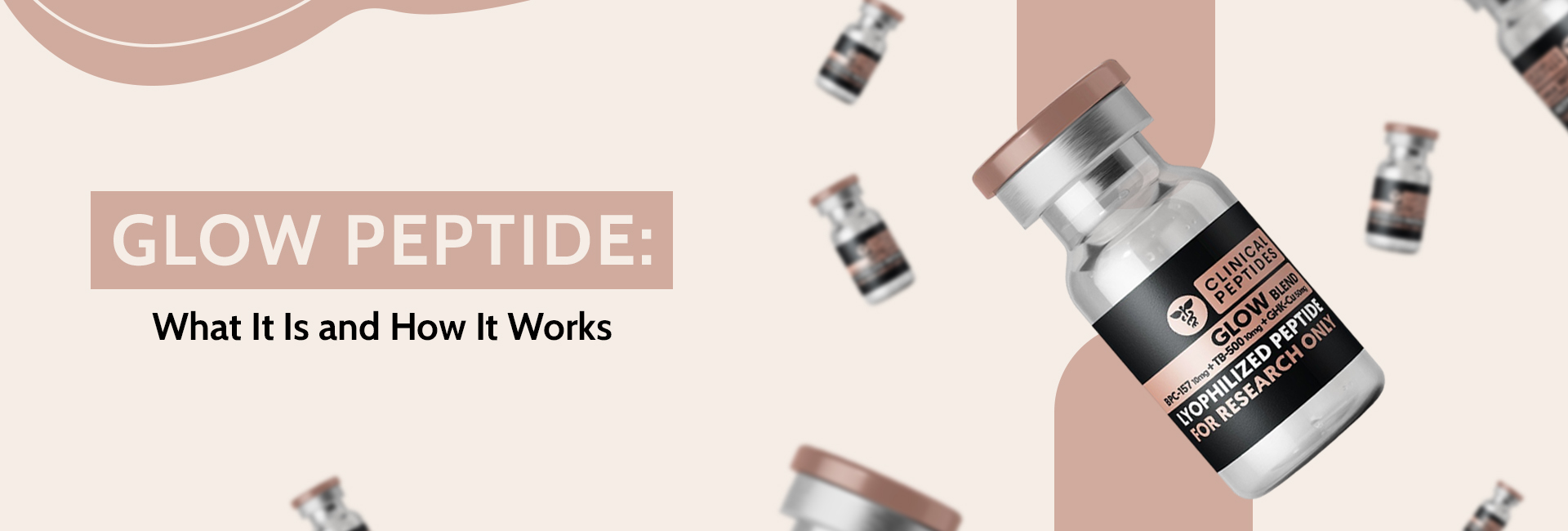
If you pick up a standard 70 mg research vial, it looks like a freeze-dried blue puck. That deep blue color isn’t food dye. It comes straight from the raw copper bound inside the main ingredient.
Inside a standard glow stack peptide mix, you get three heavy hitters:
- GHK-Cu (50 mg): The heavy weight here. It flips the switch on your Collagen I, Collagen III, and elastin genes. At the same time, it tells your body to stop producing the enzymes that break down old skin matrix.
- BPC-157 (10 mg): Popular for gut and tendon healing – but for skin, it drives angiogenesis. That means it builds tiny new blood vessel branches to carry oxygen and raw nutrients straight to aging dermal layers.
- TB-500 (10 mg): A fragment of Thymosin Beta-4. It acts on actin inside your cells, making it way easier for repair cells to migrate over to damaged or thin skin tissue.
How the Three Work Together
Running just one peptide is fine, but it gives you a single pipeline. Combining all three creates a clean sequence:
- TB-500 unglues repair cells so they can travel to the site.
- BPC-157 builds out the blood supply needed to feed those repair cells.
- GHK-Cu uses those fresh nutrients to lay down dense, structural collagen fibers.
Using a multi-ingredient glow blend peptide gets you results faster because your body isn’t stuck waiting on a single pathway to catch up.
How It Compares to Other Popular Stacks
People run different peptide stacks depending on what they are trying to fix:
| Stack | What’s In It | Best Used For |
| Glow Stack | GHK-Cu + BPC-157 + TB-500 | Skin elasticity, dermal thickness, fine lines, and radiance |
| Wolverine Stack | BPC-157 + TB-500 | Severe muscle tears, joint pain, and torn ligaments (no skin focus) |
| KLOW Stack | Glow Stack + KPV | Same skin benefits plus heavy anti-inflammatory control for eczema or rosacea |
Quality and the Glow Peptide Canada Market
Peptide synthesis is delicate. If a lab cuts corners, you end up with chopped-up amino sequences or leftover bacterial walls (endotoxins) that cause nasty red welts or infection at the injection site.
That is why search volume for trusted glow peptide canada research sources has gone through the roof. If you are looking to buy a glow peptide stack, make sure the vendor provides these three tests for every batch:
- HPLC Purity over 98%: Proves there are no broken peptide fragments floating in the powder.
- Mass Spectrometry (MS): Confirms the exact molecular weight and sequence order of the peptides.
- Endotoxin Testing: Ensures the batch is sterile and safe for use.
Mixing and Storage Rules
Peptide chains break apart easily. High heat, light, or aggressive handling will ruin your vial before you even use it.
- Reconstituting: Dribble your Bacteriostatic Water down the glass wall slowly. Never blast water straight onto the dry powder cake.
- Don’t shake it: Swirl the vial gently between your fingers. Shaking creates high friction that shears fragile amino chains.
- Keep it cold: Dry powder can handle shipping, but once you add water, keep it in the fridge between 2°C and 8°C. Use the mixed vial within 30 to 45 days.
Frequently Asked Questions
Why not just use a copper peptide serum on my face?
Topical copper serums rarely penetrate past the top layer of skin because the molecules are too large. Injecting or using systemically delivered peptides bypasses that skin barrier completely, letting your body utilize the compounds at the cellular level.
How fast will I see actual results?
Initial skin hydration and reduced inflammation usually show up around weeks 1 to 2. Actual structural changes—like firmer skin, softer lines, and better elasticity—take 6 to 12 weeks because your body needs time to physically construct new collagen fibers.
What are the side effects?
A slight stinging feeling, redness, or a small bump at the injection site is common due to the copper in GHK-Cu. BPC-157 can also cause a brief warm flush or mild lightheadedness right after application because it opens up blood vessels quickly.
Can I mix these three peptides myself?
Yes, you can buy GHK-Cu, BPC-157, and TB-500 in separate vials and reconstitute them together in one syringe. However, pre-mixed 70 mg vials save time and keep the math simple.
Who should stay away from this protocol?
Anyone with active cancer or a history of tumors should avoid this stack entirely. BPC-157 creates new blood vessels (angiogenesis) and GHK-Cu boosts cell growth, which you never want to stimulate around malignant cells. Always speak with a doctor first.
